
Over the past ten months, staff at the historic Victorian Brown House have been meticulously preparing for a year-long exhibit in honor of America’s 250th birthday, the Semiquincentennial. This exhibit displays the historical Brown House and goes into depth of the details of the history of Wylie and America as a whole. The Brown House, which is 105 years old, was built by Thomas Brown and restored back to its original Victorian style in more recent years, after the Kreymer family sold the house to the Birmingham Land Trust. Shortly after, Birmingham sold the house to the city of Wylie, who has kept it as a historical home ever since. With its eleven foot ceilings, wraparound porch, stained glass windows, grand turret, decorative wallpaper and double fireplaces, the Brown House is a truly breathtaking lense into the past.
“Research is so exciting because you have to go back and learn the truth.” Tour guide and history enthusiast Tracy Lawson said. Lawson was a dance and theater teacher for many years before becoming the curator at the Brown House. Lawson plans the exhibits and does the historical research. She is also an esteemed author since 2012, with historical adventure books based off of her own family’s legacy.
“My grandma was Anna Asbury Stone– a soldier and military wife,” Lawson said, describing the historical landscape at the time and how women’s history is so often looked over rather than recorded or depicted. “She was not content to pray and worry. She wanted to do something about it.”
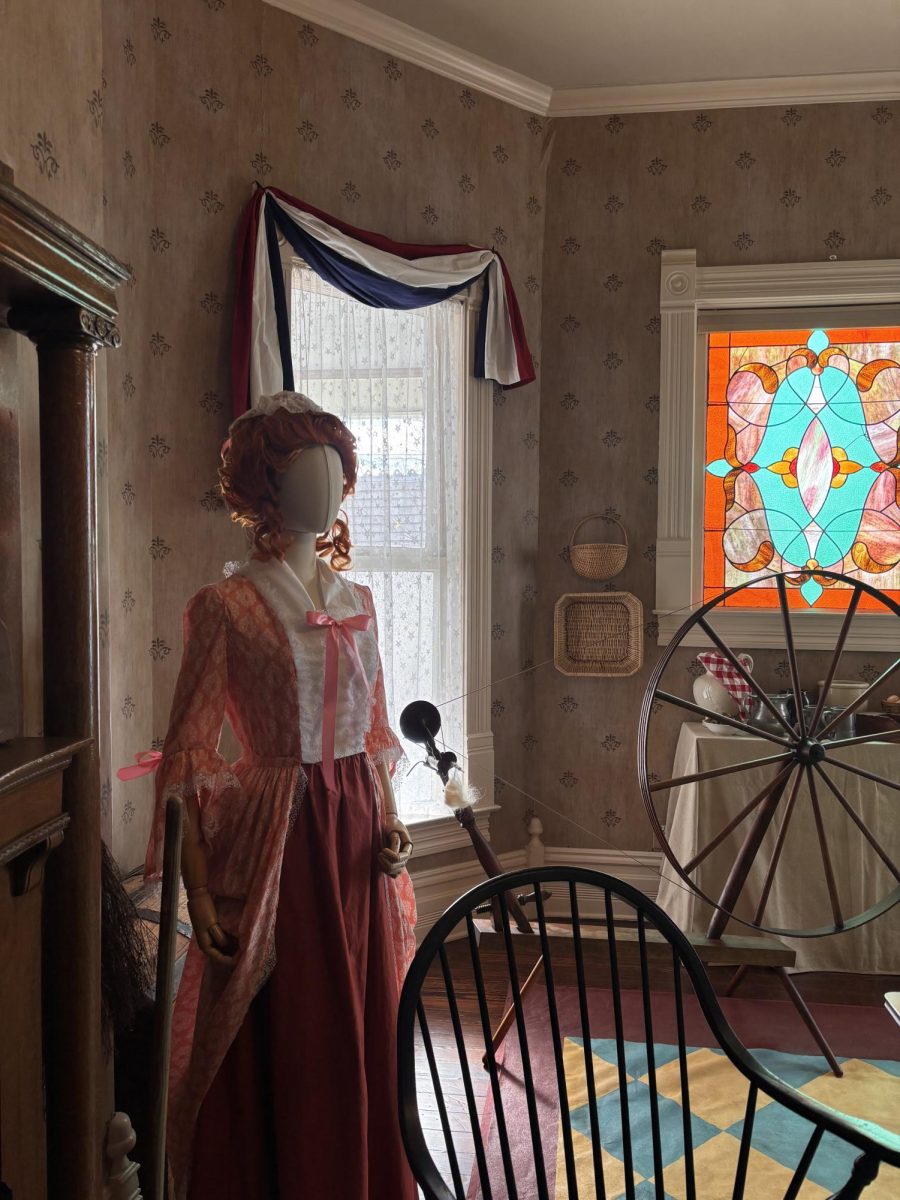
Lawson’s books display her wide range of knowledge for American history and her call to reveal the truth and bravery women of the 18 and 1900s went through even though it may be often overlooked. Lawson’s most notable series is Ladies of Revolution, which she wrote in recent years. Towards the back of the house is a historically accurate women’s chamber, displaying many things a mother or daughter might’ve had during the Victorian era, such as a Great Wheel to spin linen to fabric.
“There were no factories in the US at this time,” Lawson said. “You were responsible for creating almost everything you used.”
The process of making clothes for the ladies of the 1900s was painstaking. They had to know exactly how many sheep were necessary for the amount of fabric needed, and even five minutes of spare time were spent by women making fabric from linen and wool. Aside from the women’s room, there was a parlor which displayed photographs from long ago and a turret which had been restored in the 90s, originally used for ventilating the house.
“History is full of what ifs.” Christopher Rasso, Brown House tour guide, said. Rasso was an American history teacher for 28 years with a passion for George Washington. “Sometimes they’re good and sometimes they’re not. The truth is always in the middle. We have to take the good and the bad and learn from it.”
Rasso told tales of George Washington’s ferocity while fighting battles and his bravery on and off the battlefield. A room displayed many paintings and artifacts from the time period. It was said Washington had a belief of his own invincibility. He famously said, “Don’t worry. They can’t get me.” Whether bravery or idiocy, Washington’s legacy has shaped the world we know today, and thanks to his ferocity, we live in America today.
“It’s about legacy,” Rasso said. “If we don’t remember where we came from, we won’t recognize the future. Look at your history– look first for the goodness. It’s the goodness that’s going to last. Washington and his troops won, and the legacy they gave us lasts today. We would have no country without it. I want to focus on greatness– and become more like that.”
The Brown House Exhibit represents the late Victorian era and local Wylie history, each room complete with historically accurate and period specific furniture and pieces that complete the feel of a historical home. From revolutions to restorations, the Brown House has stood strong as a marker of history itself, a memoir of the past paused in time.
“Remember the good we did and how the good brought us to the country we live in today,” Rasso said. “Be proud of the good. That’s what gave us America.